Agentic Venture Capital: How Agents Help Us Be Better Humans
Agentic Trading vs Agentic Venture Capital
At 6MV we've fully embraced the agentic future. My near-fulltime focus the past month has been building out systems to accelerate our tight, nimble team so we can spend more time on higher leverage activities.
Most agentic finance posts center on Trading, with the goal of establishing skeuomorphic agentic Trade Desks with functions like Research, Alerts + Signals, Trade Execution, Technicals, Risk Management, etc. Essentially, the vision is to enable anyone to act as a Goldman Portfolio Manager with near-similar information and trade automated execution.
But while Trading succeeds on Arbitrage and Risk Management, Venture Capital thrives on Trust and Conviction. How does the agentic future reshape Venture Capital?
Keys to Success in Venture
The most successful firms build their reputation over years – and even decades – through repeatedly partnering with n-of-1 founders who create category-defining businesses.
Founders choose a firm for their ability to accelerate the company through influence over the category, the mutual trust created during the deal process (truly ‘vibes’) and the ability for the firm to “actually” be “value-add” and accelerate their business. For example, when founders choose 6th Man Ventures as a lead, they think to themselves, ‘can they be a design partner on my product roadmap?’ ‘Can they get me in front of the right people?’ ‘Will they answer the phone Friday at 10pm?’ ‘Will they be here to help me in 5 years?’
AI can hardly help any of these. It’s why Marc Andreessen said “When the AIs are doing everything else, [VC] may be one of the last remaining fields that people are still doing.” Unlike Trading where the goal is literally to create super-agents that earn better returns than human teams, humans will remain in the driver’s seat for the foreseeable future. The ability to influence others, support difficult judgment calls, evaluate talent and develop unique ideas are unlikely to be led by AI in the medium term.
The Venture Landscape Will Change
So how do Agents shape the future of Venture?
I think we see a bifurcation in the Venture market. As AI automates the time-consuming and table stakes elements of venture like market research, memos, diligence, deal-funding, fund ops, etc, it means that firms will either become more people-efficient or must expand their sphere of influence.
The first clear growth sector is Super Angels. As capital continues to concentrate, successful entrepreneurs will compound their balance sheets and manage hundreds of venture investments through automation. Early examples include founders like Balaji and Thiel.
The other growth will be Venture Builders. A16z has transcended being a Venture Firm; they are a political lobbyist, research house, technology lab, media platform, etc. Being a ‘value add’ investor is compounded by technology. Larger firms will need to expand their sphere of influence through adjacent efforts which shape the world to their vision of the future.
So what does this look like in practice? Over the past month we’ve built a set of agentic tools designed around the things that matter most in venture.
AI as Acceleration
Technology is leverage and speed is everything. This article hinges on the belief that AI is best to help accelerate firms, not replace human decision making.
Three ways AI has uniquely helped us accelerate are:
- (Conviction) Develop faster conviction on deals
- (Trust) Be more helpful to founders
- (Information) Enhanced liquid token monitoring & analysis
1/ Develop faster conviction on deals
Speed in deals is critical. We’ve collapsed initial deal evaluation time from one week to about 15 minutes—at roughly 1/100th the cost.
Pump.fun has been one of the best returning Venture Investments of the past three years. When asked about the deal process most people are shocked to learn that the time between first meeting and Term Sheet was about one week. While other funds were talking to the team and building a point-of-view we came in with high conviction and won the deal.
We could move with speed because as crypto-natives we had a strong, pre-existing thesis on coin creation and its democratization.
But there are many facets of crypto where we don’t have as neatly formed theses. For example, we looked at a company tokenizing public market preferred equities. We needed to quickly build a PoV across many factors to assess the deal.
One way we productized speed-to-conviction was by building an ‘Eval’ tool to generate an investment report. It combines context across all touch points with the company, unpacks all provided materials, gathers market + usage data from DefiLlama, Coingecko and others, reviews X posts and scrapes 50+ sites to gather extremely holistic context.
The user can then put in a custom prompt (eg “I also want you to evaluate the unit economics and tokenomics of the business.”) and a detailed report is generated that includes everything from investment thesis to market analysis to potential red flags.
The output will continually improve as the system learns our ideal deal profile and what traits enable winners, letting us review far more opportunities and rigorously test assumptions against supercomputer-level analysis.
Note that this thesis doc is an input to a human-centric and iterative process. The subjective parts of Venture – such as founder evaluation and reference gathering – still carry a disproportionate weight in our decision making. The output from this report is the input to the deeper diligence which requires extensive human judgement and relationships.
2/ Be More Helpful to Founders
Every VC has received a “just circling back” message from a founder. AI is already helping us not drop the ball across 100+ portfolio companies. This isn’t just ops—it’s trust-building at scale.
We help founders in many ways. Some of these are in-person deep dives (very human), but many requests are async actions like reviewing a doc or facilitating high-value introductions.
Every VC says they’re responsive. In practice, a founder’s ask comes in on Telegram at 11pm, gets buried under 40 messages overnight, and surfaces three days later as a “friendly bump.” Multiply that across 100+ portfolio companies and things slip.
These slips matter; if it takes us a week to make an introduction, that can be 5% of the company’s available runway! Speed is everything, and AI can help us be maximally supportive.
We built an agentic Todo triage system that provides situational awareness. Through a local model (no cloud) it monitors our Telegram channels, automatically extracts action items, and — critically — detects when we’ve already handled them. If a founder asks for an intro on Tuesday and I make it on Wednesday, the TODO closes itself. No inbox management, no checking things off a list. Below is a screenshot:
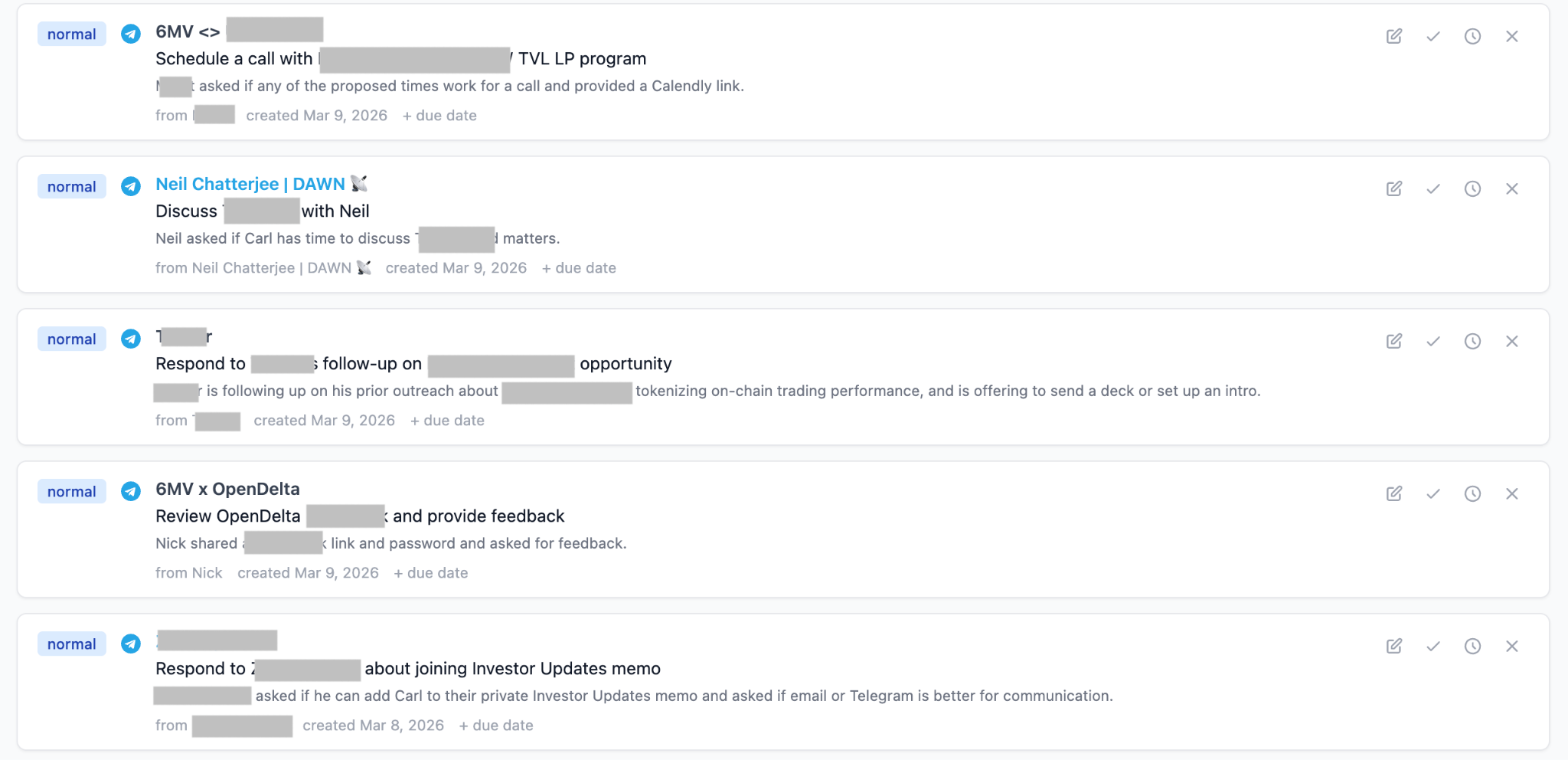
The daily output is simple: a prioritized list of what we owe people. But the compounding effect is that we now have a record of every ask and every follow-through across the entire portfolio — which turns out to be useful data we could previously never track.
The next major step will make responding to simple tasks as easy as swiping on Tinder; the system will generate draft responses that each team-member can simply click ‘accept’ or edit to move through simple ToDos rapidly.
These accelerations may seem small, but when working through 20-50 a day they compound. Our ability to quickly facilitate introductions and ensure we don’t miss actions through categorizing ToDos has been incredibly valuable in the 2 weeks it’s been live.
Outside of PortCos, it’s also helped ensure we see every deal and don’t miss the next pump.fun outcome from simply overlooking it in the inbox (yes Pump came to us through a twitter DM).
3/ Enhanced Liquid Monitoring
Every crypto venture fund is also a liquid fund; monitoring 24/7 prices and on-chain signals is table stakes.
We make illiquid investments in companies, but many of those companies yield liquid tokens that trade 24/7, requiring consistent monitoring. In addition, crypto’s volatility enables ‘private entry’ prices for public tokens.
Tracking protocol adoption across a portfolio of dozens of tokens — those we own and on our watchlist – is a full-time job.
Using AI we built a Liquid Agent that generates on-demand reports that include every key stat a portfolio manager would want to know; price history, TVL, fees, revenue, daily active users, transaction counts, open interest and more by aggregating across numerous data sources.
Since crypto announcements and sentiment is on X, we also use the xAI API to generate a news summary that includes the most important posts from the past 30 days.
The liquid agent has helped us increase our coverage, both in breadth and depth, to instantly answer questions like:
- As prices move up are fundamentals increasing or unchanged?
- How does Kamino’s utilization compare to others in the category over the past 30 days?
- Is this asset outperforming any of the majors?
We also have robust alerts; if something moves — a 100% spike in fees, a collapse in TVL — we’ll know.
For our venture portfolio, it means having the ability to have thoughtful conversations with founders like “why is DAU is up 30% this month but revenue flat” without spending hours researching each portfolio company. For our liquid portfolio, it means better entries and exits informed by real usage data. The agent isn’t just about monitoring financial positions; it’s producing real-time signals about the health of companies we’ve backed.
Wrap
None of this replaces the Friday night phone call or the conviction that comes from speaking with numerous founders in a category. But it does mean our team can operate with the coverage of a firm three times our size while staying focused on what actually wins deals — trust, speed, and genuine helpfulness. That’s the real unlock: not replacing the human parts of Venture, but finally having the bandwidth to do them well.
If you’re building and want a partner who’s fast, helpful, and human—DM us.